| visit: www.infertilitytutorials.com |
|
Luteal Progesterone (Pulsatile)
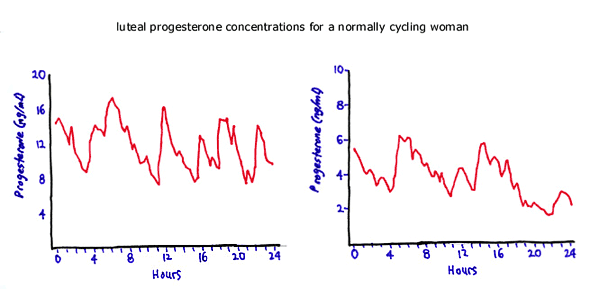
Circulating progesterone concentrations for any given woman are pulsatile during the luteal phase of the menstrual cycle (from ovulation until the onset of menses). Therefore, a single random progesterone concentration during the luteal phase (which is a commonly ordered blood test) may be misleading since it may have been drawn at the peak or the nadir of a pulse. Many reproductive endocrinologists believe that the histologic (microscopic) appearance of the endometrium (lining of the uterus) obtained by endometrial biopsy is far more accurate in assessing progesterone insufficiency. It is the progesterone effect on the lining of the uterus (which depends on the concentration of progesterone hormone as well as the progesterone receptor concentration within the endometrial tissue) rather than the progesterone concentration in the blood that is of reproductive importance. For example, high progesterone concentrations may have minimal effect on the lining of the uterus if the progesterone receptor concentrations in this tissue are low. Similarly, low progesterone concentrations may have a normal effect on the lining of the uterus if the progesterone receptor concentrations in this tissue are high. These graphs are based upon data collected by Dr. Michael R. Soules and shows that progesterone concentrations obtained every 15 minutes for a day from the same (normally cycling) woman in the mid luteal phase (left) and the late luteal phase (right) may vary tremendously, with many of the values being “abnormally low.” | |||||||||||